

I recently held an inspirational talk for a group of people responsible for one of the IT portfolios at a large bank in Sweden. They found it interesting and useful so below is an article based on it.
Improving agility at scale is one of the hardest things an organization can take on. Many companies set out to “become agile”, but few manage to change the very structures, governance, and financial steering models that hold them back.
Over the past decade, I’ve had the privilege of guiding several large enterprises through their transformations — across different industries, cultures, and continents. A clear pattern has emerged: if we want to accomplish real improvement of business agility, the most impactful transformation has to happen at the top. There has to be significant change in how we fund, govern and organize the portfolio.
Why Portfolio Management Matters
When I ask why a company chooses to organize initiatives into a portfolio, I’m often met with complete silence. There’s a lot of do’s and don’t, but very few Why’s.
One thing I’ve learned is that the likelihood of be successful with managing your portfolio is more related to clarity of the purpose than how you manage it. If a clear goal is missing then the best you can do is to hope for a couple of lucky breaks to come your way.
The simplest answer I can come up with on the purpose of a Portfolio is this:
To utilize common governance over everything within the portfolio, believing that doing so will create better results than not doing so.
In other words: portfolio management isn’t about control — it’s about enabling competitive advantage through combining different options within the portfolio into a coherent value proposition which outperforms your competitors’ propositions.
The Flow Fundamentals
A portfolio should really be viewed as more than a set of initiatives or projects. It’s a system — a dynamic network of people, processes, and tools working together to create value for customers.
Work flows into and out of this system, and how that flow is managed determines how quickly, sustainably, and happily we deliver outcomes than provide real value for our customers.
By viewing a portfolio as a system where work enters and leaves in a controlled way, it has the characteristics of a queuing system.
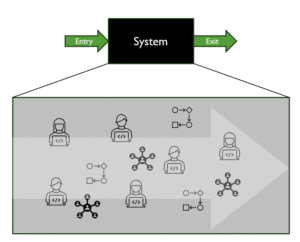
Just as gravity shapes our physical world, certain laws shape how work moves through a system — whether we recognize them or not. I call these the Flow Fundamentals:
- Little’s Law: There’s a relation between the number of ”things” in process, processing time for each “thing”, and the lead time of it through the system.
- Kingman’s Formula: Variability kills flow. Lead time in a high variability flow will be severely worsened already at low resource utilization level.
- Theory of Constraints: Improving the overall flow through a system can only be done by improving the current bottle neck.
When we start to understand these fundamentals, we stop fighting the system and instead use them to our advantage. Other ways of controlling the flow become possible.
Systems thinking and flow fundamentals are pillars of modern portfolio management, contact us to learn how you and your organization step up your game.
Creating Clarity
An effective portfolio needs three basic things to be clear for everyone working within it; scope, direction, and metrics. These provide answers to questions such as
- What’s in the portfolio and what’s out?
- Where are we heading? How is the portfolio intended to evolve? What should it not evolve?
- How do we know we’re moving in the right direction? What key metrics can be used to gauge progress or lack thereof?
Strategic themes help align teams and leaders around shared objectives, while metrics provide feedback loops that guide adaptation. The goal isn’t to measure everything, but to measure what matters — focusing on leading indicators of progress rather than lagging lack of results.
From Projects to Flow
Traditional, project-centric governance often clashes with modern product development. Projects assume predictability, but product development thrives on learning. Projects have a fixed end date, but successful products require change and adaption during their full product life cycle.
Most organizations focus mainly on project-centric governance, where projects are vehicles for major new products, change in how products or services are provided, or retirement of them. Much senior management attention is devoted to “getting it out the door”. There is lack of focus on continuous improvement and innovation.
Focus need to shift from managing projects to managing flow in the portfolio. In one large retail we started by visualizing all ongoing initiatives across domains, define clear prioritization principles, and introduce lean portfolio management practices.
Governance that Enables, Not Constrains
Good portfolio governance is about setting the minimum necessary constraints — guardrails that guide decision-making without limiting it. The same goes for portfolio operations: they should connect people, celebrate progress, and surface challenges early.
Establish minimum necessary portfolio governance, not maximum possible
Capacity management plays a key role here. Note, true portfolio capacity is not FTEs (Full Time Equivalents)! Product development is about collaboration and learning. Individuals are unique and have different skills. They too can learn and change. Interaction and teamwork have a great influence over both effort and result in work. These perspectives are not well represented by using the overly simplistic assumption that capacity can be represented by a number corresponding to 8-hour work units per day.
There is very little correlation between number of people working in the portfolio, and our ability to fulfill our business ambitions & customers’ needs. Furthermore, equating portfolio capacity with FTEs implies that the only way to increase capacity is to add people. This is simply not true.
Pull mechanisms and Queue management enable optimal flow within given system constraints. System constraints can be changed to improve flow over time, without adding people. This is where the flow fundamentals mentioned before come into play.
Capacity allocation, i.e. deciding which portion of capacity should be utilized for what, enables separation of concern & decentralized decision-making – it’s both-and, not either-or. Decentralized decision-making enables better solutions and empowers people.
Not every decision in a portfolio should be decentralized, but most development portfolios benefit from enabling aligned and parallel decision-making. An ever changing world requires better decisions and more decisions per time unit in order for the company o continue to thrive.
Prioritization with Purpose
Prioritization doesn’t need to be complicated, but it should be clear how it’s done. Start simple, evolve over time, and don’t replace thinking with formulas. Use methods like WSJF (Weighted Shortest Job First) as a guide, not a crutch. Enable re-prioritization when necessary.
In the end, business agility isn’t about being faster — it’s about learning faster what customers want, aligning better on how to provide solutions to those needs, and creating environments where people can thrive.
At Business Caddy, I help organizations find their rhythm — balancing structure and freedom to achieve meaningful results. If you’d like to explore how lean portfolio management can help your organization, let’s talk.
You can easily get in touch by using this form – we promise a fast response!